
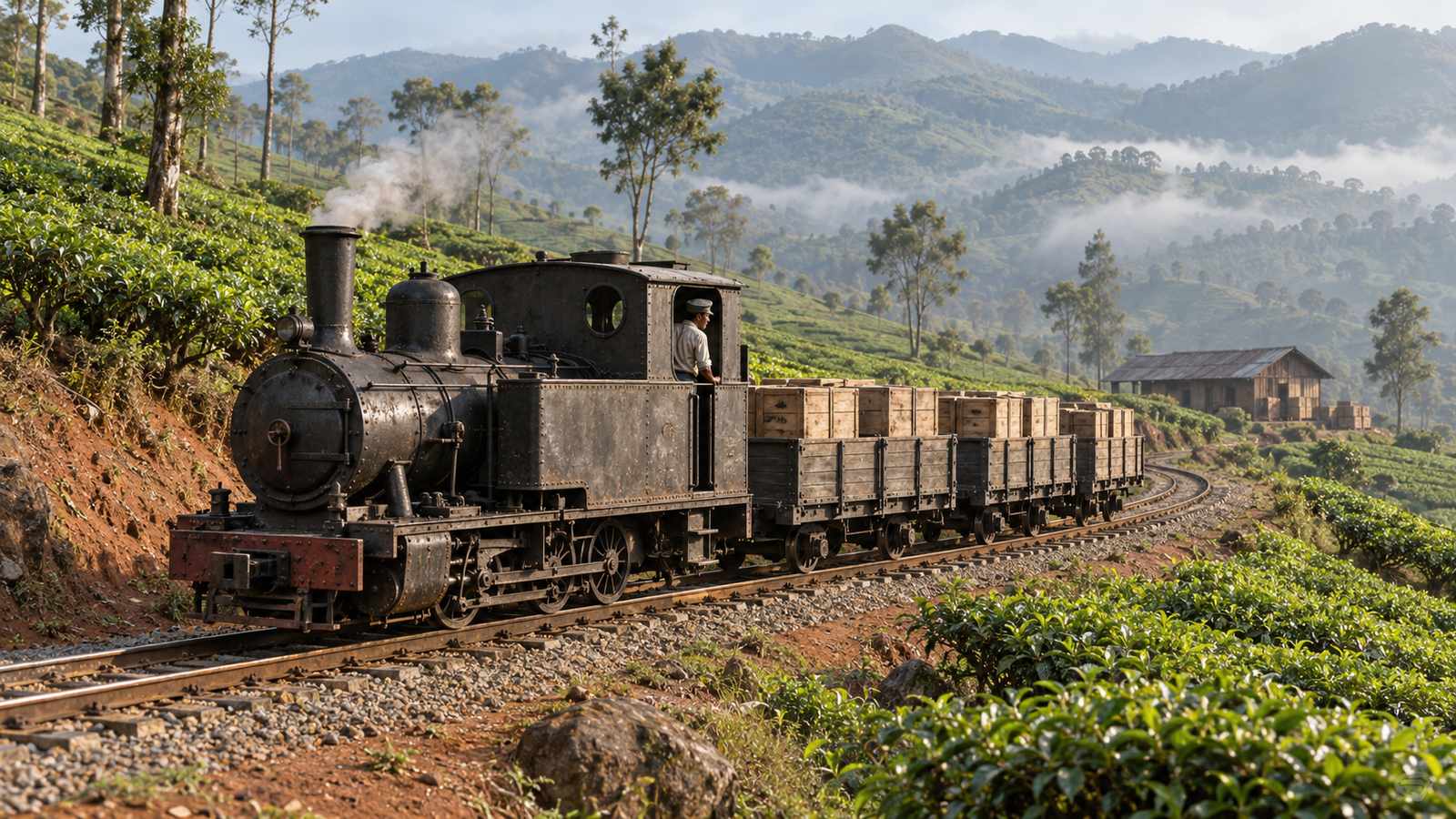
Munnar has tea gardens, misty hills, winding roads—and a railway story that surprises many visitors.
Yes, a railway once operated here.
Its name is the Kundala Valley Railway, and its main business is moving tea through the mountains. It begins with an unusual bullock-powered system, develops into a narrow-gauge railway, and meets a sudden end in the devastating floods of 1924. Today, the trains are gone. But the story gives familiar places a different meaning. Even “Top Station” starts to sound less like a catchy name for a viewpoint and more like a clue. For travelers choosing a resort in Munnar, this forgotten chapter offers another way to explore the hills: follow the history behind the scenery.
Let us rewind to a time when tea needs transport, mountains present a problem, and the answer involves rails.
Picture the plantation country at the beginning of the twentieth century. Tea leaves grow in the hills, but finished tea needs to reach markets far beyond them. Producing it is only part of the job. Moving heavy tea chests across difficult terrain is another challenge altogether.
The plantation company needs a dependable transport system linking the estates with an onward route to the plains. This is the purpose of the Kundala Valley Railway. It serves the tea industry, connecting Munnar with Top Station through the high ranges. The scenery may be excellent, but sightseeing is not the reason for laying the track. The tea has somewhere to be.
The early system, dating to 1902, looks quite different from the railway most of us imagine.
It is a bullock-powered monorail. In this arrangement, part of the load runs on a single rail while a larger supporting wheel travels on the road beside it. Bullocks provide the pulling power.
It is an ingenious combination of a cart and a railway: the rail guides the load, while the road supports the balancing wheel. There is no need to imagine a sleek modern monorail gliding above the tea gardens. This version stays firmly at ground level, and its engines require veterinary care.
The arrangement also has practical difficulties. Curves, slopes, and the condition of the road surface affect how well the carts move. Railway history records these limitations, helping explain why a more conventional system eventually replaces it.
The next chapter begins in 1908, when a narrow-gauge light railway replaces the monorail.
“Narrow gauge” simply means that the two rails sit closer together than on many mainline railways. Here, the gauge measures two feet, or approximately 610 millimeters. The change takes the system from bullock-drawn monorail carts to a railway with two running rails. Its route connects Munnar and Top Station, with intermediate stations at Mattupetty and Palaar. These names place the railway within a landscape that visitors still recognize.
What feels like a scenic outing today also belongs to an older working geography of stations, loading points, and plantation transport? For readers interested in the Kundala Valley Railway, Kerala Tourism documents its role and some of the places associated with it.
Here is one of the railway’s most interesting details: the journey does not end when the tea reaches Top Station. The location serves as a transfer point.
Tea chests move from the hill transport system onto an aerial ropeway that carries them downhill towards Kottagudi, also known as Bottom Station. From there, onward transport takes the cargo towards the plains and eventually the port at Tuticorin, now called Thoothukudi.
The distinction matters. The Kundala railway itself does not run all the way from Munnar to the sea. Instead, rail, ropeway, and onward land transport work together. Imagine the planning involved: load the chests, move them through the hills, transfer them at the upper station, lower them by ropeway, and arrange the next stage. A cup of tea has a surprisingly busy travel history before anyone adds milk.
In 1924, severe flooding devastates Munnar and its surroundings.
The disaster is remembered in Kerala as the Great Flood of ’99. The “99” refers to the year 1099 in the Malayalam calendar, rather than 1999. The flood destroys the Kundala Valley Railway, and the line is never rebuilt. What begins as a solution to mountain transport becomes one of the region’s major industrial losses. This is not a story of a railway gradually losing passengers or quietly disappearing from a timetable. A natural disaster breaks the system. For the plantations, the need to move tea remains. But the railway’s operating life comes to an end.
Rebuilding a railway requires much more than replacing a few rails. A working line depends on a stable route, supporting structures, equipment, and facilities for handling goods. Extensive destruction makes restoring the Kundala system impractical. Historical accounts describe the railway being dismantled and a ropeway network taking over transport duties.
The important point is that plantation transport continues through other arrangements. The lost railway does not resume its former role. That is why this chapter feels so unusual. The railway is a real part of Munnar’s past, yet it leaves no operating heritage train for visitors to board. There is a story to follow, but no return ticket to buy.
The most accessible connection is the landscape itself.
Munnar, Mattupetty, and Top Station are more than dots on a sightseeing itinerary. Together, they help locate the railway’s former transport corridor. Kerala Tourism also identifies the former main station building in Munnar with the plantation company’s regional office. Such reuse shows how an industrial building can gain a new purpose while retaining an older story.
However, this is not a continuous preserved railway trail. Before looking for specific remnants, ask locally about their location and access. An old-looking piece of metal deserves investigation, not an immediate promotion to “historic railway track”.
If you are planning your wider journey, our guide to places to visit in Munnar helps you organize sightseeing around the region. The railway story adds context to that journey without turning it into a hunt for a train that no longer runs.

The forgotten railway reveals a practical side of Munnar.
Behind the peaceful views lies a history of people solving difficult transport problems. They experiment with a single rail and animal power, adopt a narrow-gauge line, and adapt again when disaster changes the landscape. Knowing this gives familiar place names more depth. Top Station becomes a transfer point in your imagination. Mattupetty becomes part of a working route. The hills become a place of movement as well as beauty.
After exploring, enjoy a quieter evening in Chinnakanal, perhaps with a cup of tea and a new appreciation for the effort it once took to transport it out of the hills. If you’re staying at The Siena Village, its rooms and cottages offer a place to unwind. Munnar’s railway no longer carries cargo, but its story adds another layer to the landscape.
Follow Us On


Drop your Queries
Adventure and Outdoor Activities
Attractions / Destination Guides
Culture and Cuisine
Travel Tips and Advice
Resort Facilities
Wellness and Ayurveda
Seasonal Highlights
Recent Post


