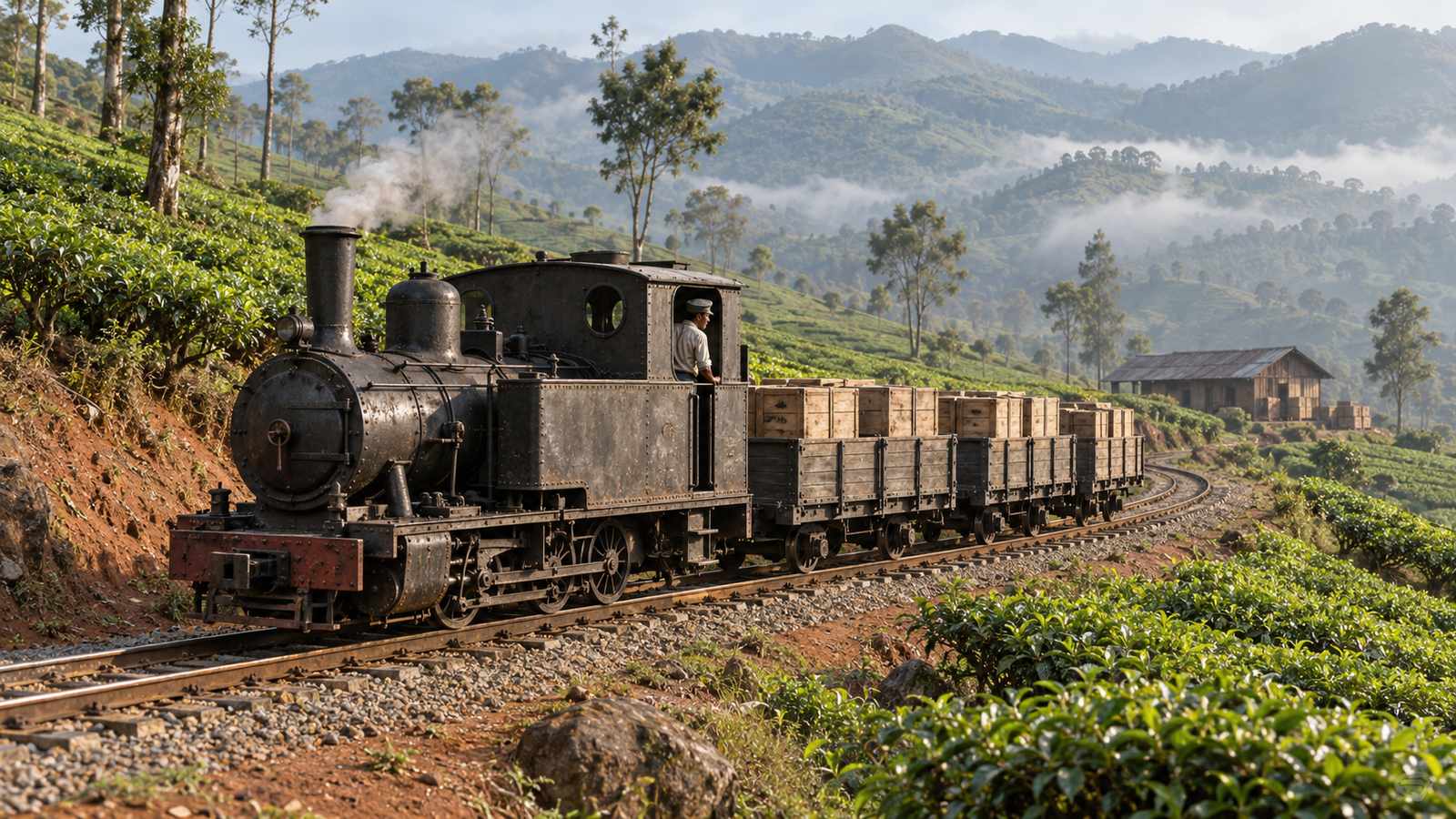
Look out of your window while travelling through Munnar, and you may notice something unusual about the hills. They do not simply look green. They look carefully arranged.
Small leafy shapes sit beside one another, separated by narrow gaps. Rows bend around the slopes. Some patches look like soft squares, while others stretch into long green ribbons. It is almost as if someone started a giant jigsaw puzzle and decided that every piece should be tea.
But why does it look this way? Are the bushes deliberately shaped into squares? And who gives an entire hillside such a tidy haircut? The explanation includes clever planting, regular pruning, and one detail visitors rarely think about: how far a tea picker can comfortably reach.
From a distance, Munnar’s tea gardens can look like one continuous carpet. Up close, that carpet breaks into individual bushes and closely planted rows. Tea comes from a plant called Camellia sinensis. Without regular cutting, it can grow much taller than the low bushes seen in commercial plantations. Growers encourage the plants to develop broad, branching shapes and keep them at a manageable height. Their leafy tops gradually fill the available space.
The gaps between them help outline the shapes, creating that familiar puzzle-like appearance.
While staying at The Siena Village in Chinnakanal, Munnar, looking for these patterns can add a little curiosity to your sightseeing drives. You might begin by admiring the scenery and end up wondering who planned the green seating arrangement.
Here is a detail that makes the whole picture more interesting.
Tea plantations must be arranged so workers can reach the fresh shoots. A hillside covered in one enormous, uninterrupted bush might look impressive, but harvesting its middle would be quite a challenge. Plant spacing and access paths help workers move through the field and reach the harvesting surface without pushing through the plants.
In some planting systems, beds are arranged so the leafy canopy can be reached from paths on either side. The exact spacing varies with the estate, terrain, and harvesting method. Think of a dining table. If it becomes too wide, someone eventually has to ask, “Could you pass that from the middle?” A tea field has a similar practical problem, except there are thousands of leaves to collect.
The beautiful pattern is partly an arrangement that makes the crop accessible. What looks like landscape decoration also helps people do their daily work.
Sometimes, yes—but square planting and square-looking bushes are not quite the same thing.
In a square planting system, the distance between plants is equal in both directions. Imagine dots placed at regular intervals across a sheet of paper. Tea cultivation also uses rectangular arrangements and hedge systems, where plants grow closer together along rows. On hillsides, rows may follow the contours of the land.
As plants spread and their tops are maintained, their foliage can create rounded, roughly square, or connected shapes. So a patch that looks like a neat green square from the road is not necessarily a bush trimmed into four perfect corners. Its appearance may come from the planting layout, the surrounding gaps, and the way its branches have grown.
The hills are organized, but nobody needs to inspect every bush with a geometry set.
Look carefully, and you will notice that the tea plantations in Munnar are rarely one uniform shade.
Fresh growth can appear lighter than older foliage. Different tea varieties may also vary in colour. Recently pruned areas can look more open than neighboring bushes with fuller growth. Sunlight adds another layer. One slope may glow while another sits beneath a cloud’s shadow.
The view can change before you have even finished taking a photograph. You cannot always identify the cause from a distance, but those changing colours show that the plantation is a growing, changing landscape. If this makes you curious about the journey from fresh leaves to finished tea, our Munnar Tea Museum guide offers a natural next chapter.
Tea gardens look peaceful, but their appearance depends on ongoing work.
People harvest shoots, care for plants, maintain access routes, and manage the fields. The scenery is also someone’s workplace. Enjoy the patterns from permitted viewpoints or safe stopping places. Enter plantation fields only with permission, follow local instructions, and ask before photographing workers. There is no need to squeeze between bushes for a better photograph. The puzzle is best appreciated with all its pieces undisturbed.
After a day of exploring, return to comfortable accommodation in Munnar at The Siena Village and settle into a slower evening. A cup of tea may feel slightly more interesting now that you know the planning and effort behind it.
Munnar’s tea gardens look like a giant green puzzle because planting patterns, branching bushes, carefully maintained tops, and working spaces come together across the slopes. The lesser-known detail is wonderfully simple: the layout helps people reach the leaves. History and hillside farming add their own influence, shaping a landscape that visitors often admire without fully understanding.
On your next drive, look beyond the green. Notice the gaps, the curves, and the width of the leafy patches. You are looking at a beautiful landscape that has work to do.

Discover why Munnar’s tea gardens look like a giant green puzzle, with fascinating details about square planting, pruning, and how workers reach the leaves.
Follow Us On


Drop your Queries
Adventure and Outdoor Activities
Attractions / Destination Guides
Culture and Cuisine
Travel Tips and Advice
Resort Facilities
Wellness and Ayurveda
Seasonal Highlights
Recent Post